Do you know the tradition and the reasons behind celebrating Mardi Gras? How about the origin of the King Cake or observing Lent?
Being the Baptist girl that I am, I didn’t grow up with these traditions, so for years, I assumed these were simply fun days to party and eat the most delicious pastry (with a plastic baby hide inside), then diet for the next 40 days.
However, as I began to research the origin of these celebrations, they have come to mean so much more to me. The root of these festivities can actually be found in Biblical truth and in Jesus Christ.
The season of Lent begins the day after Mardi Gras.
Basically, Lent is a time when many Christians prepare for Easter by observing a period of fasting, repentance, moderation, and spiritual discipline. Though this is not a Biblical mandate to celebrate, those who observe Lent see it as a season to set aside time for reflection on Jesus Christ – His Cross,His suffering and His sacrifice, His life, death, burial and resurrection (John 13-19).
Lent follows the Liturgical seasons of Advent and Epiphany, where we seek and find Jesus, celebrate His coming into our lives, and determine to follow Him into the new year. From fellowship and intimacy with our Holy God inevitably comes the realization of our sins. And that’s where Ash Wednesday comes in, where Lent picks up, and we are led into the blessed celebration of Easter.
However, before Lent begins, there is Mardi Gras.
Mardi Gras – literally means “Fat Tuesday” in French.
The name Mardi Gras comes from the tradition of slaughtering and feasting upon a fattened calf on the last day of Carnival (see below). Additionally, Mardi Gras is known as Shrove Tuesday(from “to shrive,” or hear confessions), or Pancake Tuesday.
{The custom of making pancakes comes from the need to use up fat, eggs, and dairy before the fasting and abstinence of Lent begin. (This explains why IHop often gives out free pancakes on Fat Tuesday…Which I was so glad to have figured out! – It puzzled me every year!)}
Less known about Mardi Gras is its relation to the Christmas season, and that the days following Christmas in many Liturgical cultures are known as Carnival.
The word Carnival comes from the Latin words carne vale, meaning “farewell to the flesh (or to meat).”
“The Carnival season kicks off with the Epiphany, also known as Twelfth Night, Three Kings’ Day, and, in the Eastern churches, Theophany. Epiphany, which falls on January 6, 12 days after Christmas, celebrates the visit of the Wise Men bearing gifts for the infant Jesus. In cultures that celebrate Carnival, Epiphany kicks off a series of parties leading up to Mardi Gras.” (The Roots of Fat Tuesday)
In the last several centuries, this time of year was also considered the “social season.” Sadly, what began as joyful celebrations before the Christian Lenten season has turned into a season of revelry rarely resembling its roots. Don’t get me wrong – I enjoy a family-friendly Mardi Gras parade, but I don’t want to think of Mardi Gras as my last chance to “get all my sinning done” for the next month or so. (Like the day before we begin a diet… haha).
Instead, I want to celebrate the FREEDOM we have in Jesus Christ to live fully and joyfully in Him. We can certainly do this without dishonoring God or our testimonies.
King Cakes
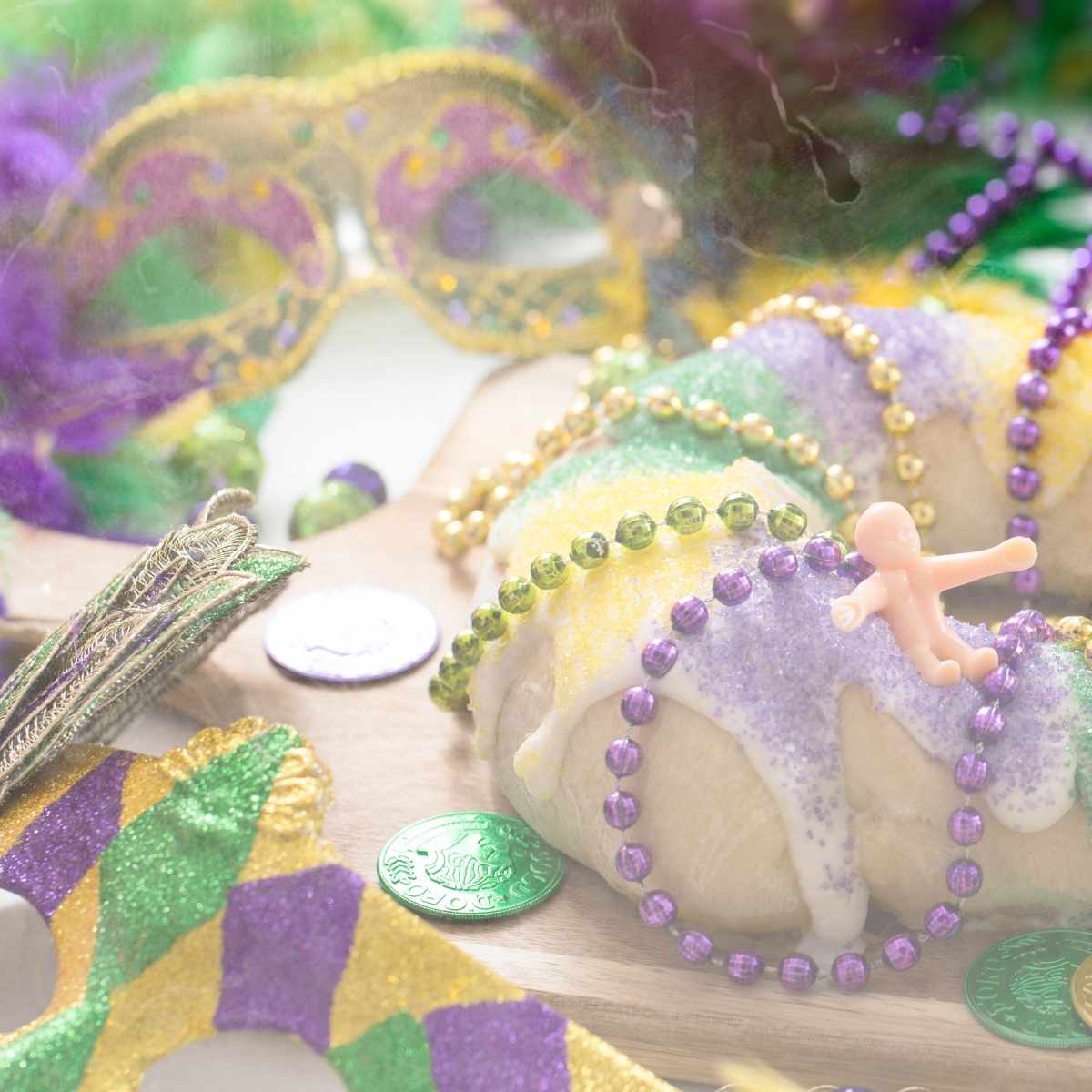
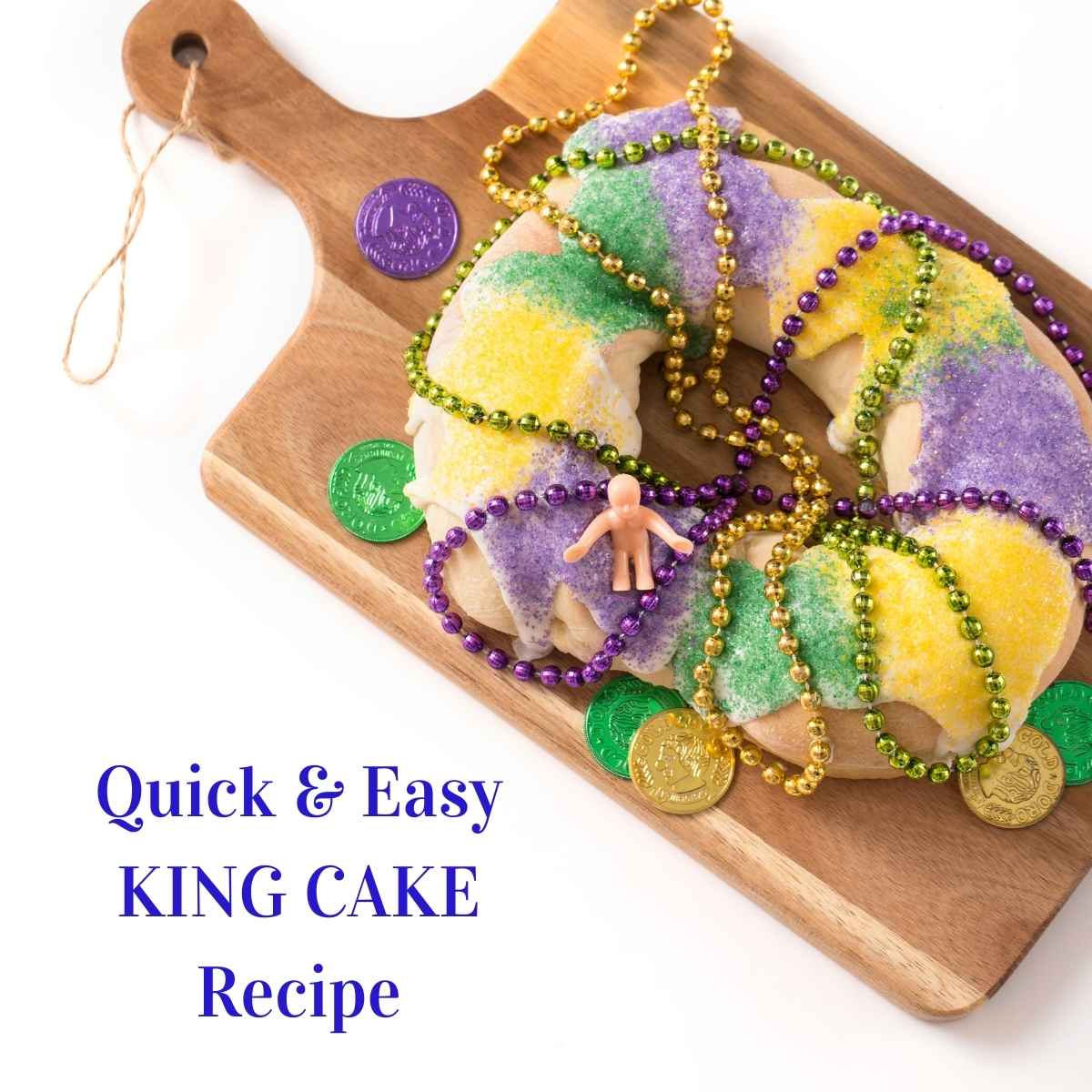
During the longer Epiphany season (from Christmas until Lent), many (including us!) enjoy a popular treat, King’s Cake. The King Cake (which is really a yummy iced cinnamon roll/cream cheesy-type pastry) is said to have originated in France in the 12th century as a celebration of the coming of the Three Wise Men bearing gifts for the Christ Child.
Part of the celebration was the baking of a King Cake to honor the Three Kings. Legend has it that the cakes were made in a circle to represent both a king’s crown and the circular routes that the Wise Men took to find Jesus, in order to confuse King Herod and foil his plans of killing the Christ Child.
In the early King Cakes, a symbol of baby Jesus was hidden among the dough. Later, Jesus was replaced with a coin, pea, pecan, or bean that was hidden inside the cake, and whoever found the item was said to be “king for the day” or was declared blessed or lucky for the rest of the year.
When the King Cake was brought to Louisiana by French settlers in the 1870s, bakers began putting the small baby (representing the Christ Child) back in the cake. Now, the one who finds the baby in his/her piece of cake is said to be extra blessed and is expected to host the next King Cake party.
One more FYI: The three colors of Mardi Gras and the King Cake are Purple, which stands for God’s justice, Green for people’s faith in Jesus, and Gold for God’s power over all. And that = Jesus.
Want to make your own King Cake?
Quick and Easy King Cake for Mardi Gras
Ingredients
CAKE
1 12oz tube refrigerated crescent rolls
4 oz cream cheese, softened
1/4 cup powdered sugar
1/2 teaspoon vanilla extract
1/2 cup chopped pecans
1/4 cup brown sugarFROSTING
3 cups powdered sugar
1/4 water
1/2 teaspoon vanilla extract
Purple, gold and green sugar sprinkles
Instructions
1. Preheat your oven to 350 degrees and line a cookie sheet with parchment paper.
2. Roll out tube of crescent rolls on parchment lined cookie sheet, pressing the seams of the dough together to form one large layer of dough.
3. Mix cream cheese, 1/4 cup powdered sugar and and 1/2 teaspoon vanilla extract and spread it along the center of your dough.
4. Cut a few slits in the sides of the dough to make flaps that can be folded over the filling.
5. Sprinkle brown sugar and pecans over the cream cheese.
6. Fold the flaps over the filling to make a “braid” and pinch together any holes along the bottom so the cream cheese doesn’t leak out while it’s baking.
7. Gently form the dough into a ring on the cookie sheet.
8. Bake in the oven for 15 minutes.
9. While cake is baking, mix together the frosting: 3 cups powdered sugar and 1/4 cup water with 1/2 teaspoon vanilla extract. This mixture will be rather thick.
10. When your cake is out of the oven, spread it in a ribbon around the top of the cake, a section at a time. You have to work quick to add your sprinkles before the icing hardens after you put on the icing.
11. The finishing touch is the baby. Slip it under the cake and see who gets to hit the kitchen next to bake up another cake!
Another Easy King Cake Recipe: King Cake Rolls
King Cake Rolls 32 bites
For the Rolls
1 (8oz) package cream cheese, softened
1 cup powdered sugar
1 tsp lemon juice
2 tsp cinnamon
2 cans (8 oz each) refrigerated crescent dinner rolls
For the Glaze
1 cup powdered sugar
2 Tbsp milk
yellow, green, purple sugar or sprinkles
Preheat oven to 350 degrees.
Beat cream cheese, 1 cup powdered sugar and lemon juice with mixer until well blended.
Press dough together to create a large rectangle. Sprinkle the rectangle with cinnamon, then spread cream cheese mixture over the entire rectangle. Roll the dough into a long log, then cut in 1.5 inch sections. Place in a cake pan. {Make this just as you would cinnamon rolls.}
Bake 13 to 15 min. or until golden brown. Cool slightly.
Mix together remaining 1 cup powdered sugar and milk. Spread on top of King Cake Bites and sprinkle with colored sugars or sprinkles.
An even Quicker and Easier version if you don’t have time to mix anything together:
Place a roll on cinnamon roles into a bundt pan and bake according to directions. Once done, remove from the bundt pan, let cool, then ice with half of a tub of Cream Cheese icing. Sprinkle colored sugars or nonperils on top, and enjoy. 🙂
So – while you’re feasting on your King Cake, pancakes, meat meals, or whatever else it is that you plan to enjoy, may you remember the origins of these observances and glorify God in the midst of your celebrating.
The Lord’s blessings upon you all~
PS: For more about the season of Lent, check out this post with three of my favorite free resources.